• Image

    We launched the Revision Access system later in the term than I would have liked, but now that it’s up and running there is finally some user data to start garnering insights from.

    It’s certainly working; the log shows students revising through the half term, some of them with considerable diligence. However, I see some problems that I want to address.

    Give everyone access

    First and foremost, by making it a separate product we denied access to a lot of students who would have liked to use it. It may surprise you to know that there’s a major thread on the students’ forum demanding more quizzes, so we know there is an unfulfilled demand.

    So from September, Revision will be a standard feature of Yacapaca, available through your existing subscription – even through free subscriptions. We will put it on the same meter as regular quizzes, with appropriate teacher controls to ensure you use up only the credits you choose to assign.

    Better topic management

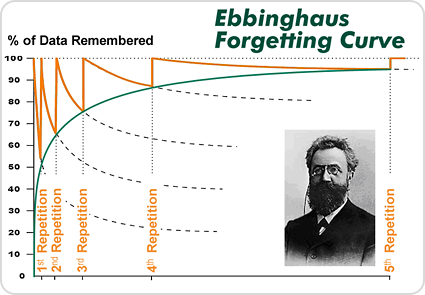
    With Revision, students are supposed to indicate which topics they have completed, and then retain those topics in their lists. Yacapaca will automatically construct a spaced-practice review schedule, using Ebbinghaus’ principle. What I’m seeing in the usage logs is that many students don’t understand this. They are adding topics that are not useful to them, e.g. I see the same student adding both A-level and KS3 topics.

    The solution will be to constrain what students can revise to only the syllabi of their student set. Technically, that is quite easy. I’m also wondering if we can parse from the quizzes they do which topics have been covered, so they can’t run on and try to revise topics that have not been covered in class. I suspect making that work reliably would require a fair bit of artificial intelligence.

    At the same time as adding topics not yet covered, some students are clicking off the topic once they feel they have revised it. Without reinforcement, they are going to have forgotten it again by the time they get into the exam. We will have to move the ability to remove topics from the list back to teachers. I’m a little hesitant about that because it undermines the ‘student in charge’ philosophy, but I see no option if we are going to support students to revise as effectively as possible.

    More motivation

    Revision already uses the points and avatars that motivate students to do quizzes. I want to add teams as well. You may know that I’m wary of individual leaderboards, because for every winner, you create a loser. It’s at best net-neutral. Teams are different. Properly selected and maintained, they give even the weakest student in the class a taste of what it’s like to be a winner – and once they get the taste, they’ll want more of it.

    Teacher feedback

    Currently, Revision offers no built-in tracking tools of the kind you have in the rest of Yacapaca. The data is all there; the reporting pages are simply not built yet. I’m still trying to work out just what’s needed; but there certainly should be something in place next term. Once it’s there, we can refine it with your feedback.

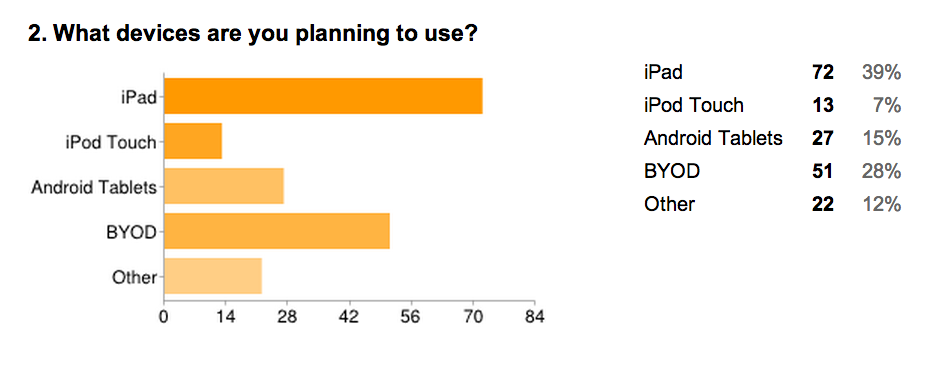
  • I’m very pleased to have had as many as 140 responses to the survey. The answers to the multiple choice questions were fairly predictable:

    ImageThe transition to mobile is well underway, with the usual spectrum of early- to late-adopters.

    ImageiPads are where it’s at, but the strategy really has to embrace everything. At least no-one said “Google Glass” yet.

    As always, the insights were to be found in the comments. Some teachers see no benefit whatever to mobile

    …everything you can do on a iPad or Android device can be done on a PC.

    whilst others are looking into an exciting future, even if they don’t yet know in detail how to manifest it

    Less didactic teaching – more project based, providing resources, more group work, personalised learning, learners making choices about when they take assessments, learners choosing the materials that suit them best…

    and of course many simply express uncertainty.

    It seems most teachers at the start of the process are asking themselves the question “Can I (or how can I) run the existing system more efficiently with this new tool?”

    Those further down the track are starting to discover that usage evolves under its own logic, if you let it

    My sixth form students already use their own devices,initially  the biggest change I found that when asked a question they unsure on they turned to Google,  but they altered as they settled in  to the use in the classroom, attempting to answer first and then googling to see who was right, it was nice to see the development from reliance on the device to using it to support the knowledge they had.   (It wasn’t an easy path though!)

    What I hope to see if we run the same survey next year is that a few have moved beyond the current framework, and instead are looking outside education for inspiration. Apps and services like Foursquare, Google Goggles and Ease into 5k use a mobile devices’ sensors and capabilities to deliver experiences that are simply not possible in any other way. None of these three are particularly intended as educational apps, but each has potential. More importantly, they inspire us to look beyond classroom and curriculum, and into a new way to develop the minds of our young charges.

  •  

    The best time to plant a tree is 40 years ago. The second-best time is today.
    Chinese proverb

    I originally conceptualised Yacapaca as system that would be entirely teacher-controlled and teacher-led. That fits the market well, but I have always had a nagging  (more…)

  • CAN

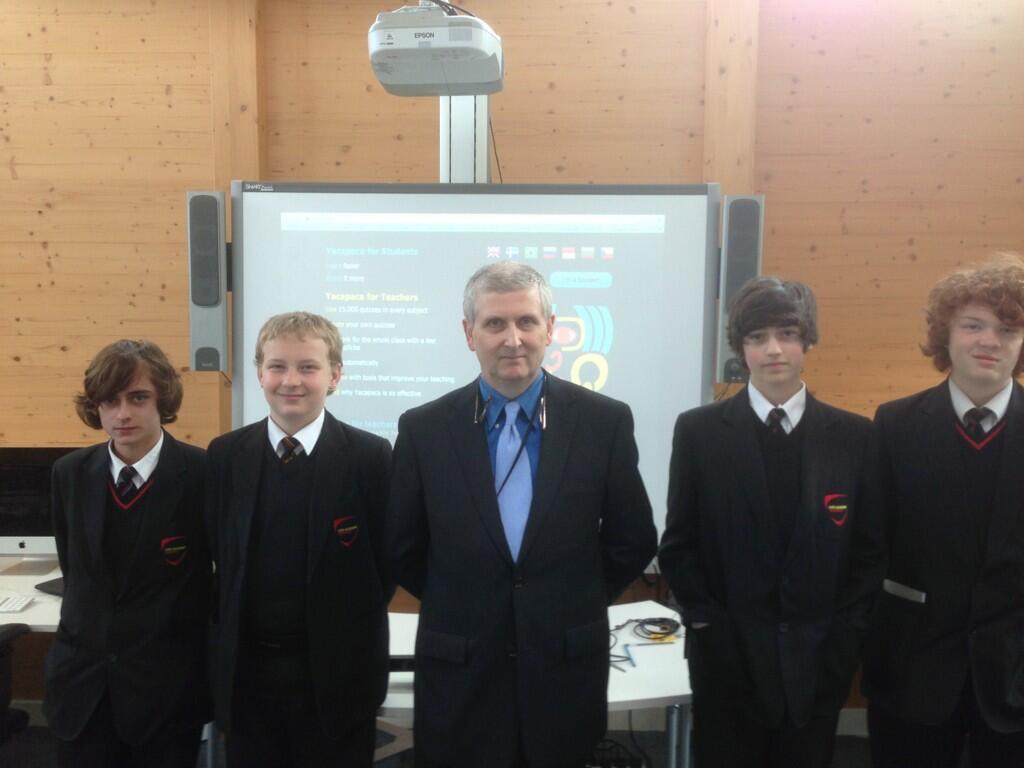
    I visited City Academy Norwich on Friday, to observe some lessons with Matt Wells and Jez Thompson. It was a particular pleasure to meet Jez; I have known him for donkey’s years, but we had never actually met.

    What struck me about the three lessons I observed was that there was no chalk and talk whatever. None. I don’t know if this is a school policy, but if it is then I approve. All the research shows that talking at kids doesn’t work; I suspect it actively inhibits their ability to learn by turning them off the whole experience. What I saw at CAN was kids on task, all the time. Some of that was Yacapaca, some was other activities.

    This was also my first opportunity to observe a Year 9 Computing lesson. I was amazed and delighted at the range of tasks the students were undertaking, and the level of engagement the tasks generated. Jez had each student either working on their own task, or in pairs, on a carrousel system. I had not seen this done before in such a fine-grained way, and it was extremely effective. Students were focused much more on their own tasks than what their peers were doing, and as a result were almost completely self-managed.

    My actual aim in going was to test out our (very) experimental “Tortoise and Hare” quiz template. And I’m glad I did, because results were fairly mixed and I think I would have missed the nuances of this had I relied only on third-party reports and log data. T&H has potential, but it’s a long way from ready. We shall iterate, and test again. I suspect there will be several rounds of testing before I am happy with it, so don’t expect to see it in production any time soon.

  • We have just updated Yacapaca with what I think is one of the most profound changes we have made.

    It’s called Self-Calibration. Your students will meet it as soon as they start their next quiz. Here’s why and how it works.

    Charles Darwin said that “Ignorance more frequently begets confidence than does knowledge”. You probably know students who consistently overestimate their own abilities. It is an emotional defence mechanism known as the Dunning-Kruger effect.  Students who over-estimate their own abilities are less likely to study and thus drive themselves into a vicious spiral of failure and denial.

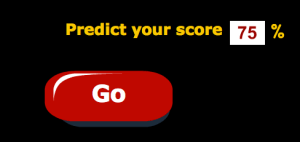
    Self-Calibration introduces a gentle but persistent way for students to build and ‘own’ a realistic view of their own abilities. At the start of each quiz, we ask the student to simply  “Predict your score”.

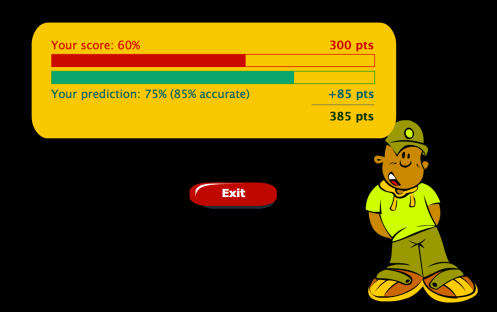
    At the end of the quiz we assign extra motivation points (that they can spend on new avatars) according to the accuracy of the prediction. Result? Over time, students start to care about self-calibration, and to get better at it.

    Self-Calibration appears automatically on all Yacapaca quizzes; you do not need to do anything to enable it. Please do observe it in action, talk to the students about it and give me feedback below on how well it is working.