• I received a long and very thoughtful email yesterday from Calum Munro, who teaches IT in Melbourne, Australia. Calum said

    Yacapaca is not … a resource to ‘over use’ as the students have a low concentration/interest span and if they use a quiz a lot (even with the shuffling that the program does) they just start to (more…)

  • Over on the TES R.E. Forum, user fpno asked

    Are there any data protection issues with inserting the names of our students into [Yacapaca]?

    It’s a question that (quite rightly) comes up regularly, so I thought it worthwhile to reflect here the answer I gave in the forum:

    Under the Data Protection Act, you have a general responsibility to store and use your students’ data safely so, yes, there is an issue. You have to be sure that Yacapaca is at least as safe as the conventional alternative, and preferably safer. Here is what Yacapaca does to give you that reassurance:

    • Yacapaca’s digital site security is better than that of most banks’ online banking sites. See this report for details of how that is measured.
    • The site is hosted at Interxion London, one of the highest-security data centers in the UK. Here is their safety/security page.
    • And if somebody did get through all of that, there isn’t much they could do with the data. Yacapaca does not store students’ email addresses, so there is no way to contact your students other than through you.

    Now let’s consider the alternative you are moving from. Most teachers are moving to Yacapaca from paper notebooks and worksheets. How secure are they? Do you ever leave a pile of notebooks in the back of the car whilst you pop into the shop? Probably. If you take them home, do keep them in a safe overnight? Of course not. I have never known students’ notebooks be treated as a security risk, but in fact they contain the exact same type of data that Yacapaca does.

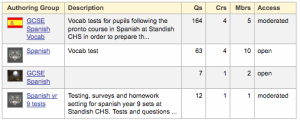
  • A conversation with established Yacapaca author Nick Verney reminded me that about 16 months ago I overviewed the very nascent state of Spanish language resources. There were seven groups, of which five were public. None had really got off the starting blocks. Here is what they looked like:

    Spanish 1

    I predicted a shakeout and offered tips for those who wanted to run the most successful group. A year and a half later, this is the result:
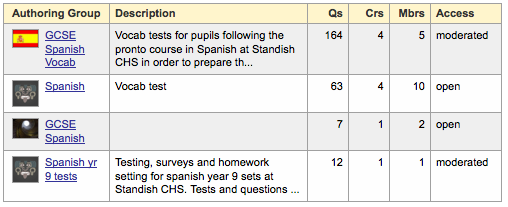
    What a difference! In total, we’ve seen 2,400% growth in that time. I am not sure if some of the old groups have disappeared or been renamed, but either way there are clearly two groups that have succeeded (out of a total of 15 now; the rest are so small they don’t appear in the list).

    The top group is Nick’s (no surprise there). So, Did he follow my advice? Well, partly. The group certainly is well named and described, with a good colophon. But Nick has restricted membership to his own department, rather than keeping it open as I recommended. I’m beginning to think he may be right about this; a tight authoring team is hard to build remotely.

    I also recommended that authors produce a range of objective and subjective (free text) material. Nick and his group have ignored free text altogether, but they have worked hard to introduce variety into the quizzes. They use the full range of question types, with lots of images and sounds. They also integrate them with resources from elsewhere, which I think is excellent practice.

    So Nick scores 10/10 for a great group which produces excellent, and popular, Spanish resources. I think I’ll give myself a 5 and a “must try harder”.
  • Inspired by this video and its associated commentary, I have updated our Guy Fawkes resources. Take a look, and let me know what you think.

  • My favourite course this month is GCSE Spanish Vocabulary by Nick Verney at Standish Community High School, for the marvellous variety of question styles and excellent use of sound. Try this quiz on adjectives to get a flavour.

    A selection of the newest courses below. If setting any of these for your students, please remember Yacapaca etiquette: offer concise and constructive feedback when asked.

    1. BCS BCS coursework
      Portfolio for Business & Communication Systems (BCS) coursework, linked to the King’s High School course for the OCR syllabus.
    2. BCS Conyers GCSE BCS
      A sequence of 8 quizzes for Business and Communications Systems. If the author provides some information about the syllabus or materials they link to, they will be really useful.
    3. Biology Biology (AQA B1)
      Tests for B1a and B1b, to be extended in due course.
    4. Biology Intermediate One
      Intermediate One (Scotland)
    5. Biology KS3 Biology
      Quizzes on respiration, and food & digestion
    6. Business Business Studies
      GCSE ICAA Business Studies for year 10 and 11 student. Robert May’s School in Hampshire.
    7. Business OCR Business Studies GCSE
      A very exciting project designed to complement the Teaching Business website and its materials.
    8. Chemistry AQA Additional Science Y11
      AQA Y11 course by topic
    9. Chemistry Chemistry (AQA C1)
      AQA C1 Chemistry course.
    10. French French Comprehension
      A five-question comprehension exercise, with the questions in English.
    11. ICT AS ICT
      Five short-text tests with well-written markschemes.
    12. ICT Network Management
      One quiz on network management, designed for the BTEC National Diploma in IT.
    13. ICT Web Design
      Web Design covering topics of best design practices, and tools to asist you in your design.  Questions in HTML, XHTML, CSS, SQL, and PHP
    14. Literature (English) Beowulf
      The same quiz offered in two different formats:
      • Beowulf and His Adventures has feedback after each question.
      • Beowulf’s adventures puts all the feedback to the end
    15. Literature (American) To Kill a Mockingbird
      These three short quizzes cover the whole book and will give you an excellent snapshot of your students’ understanding of the work.
    16. Literature Greek Mythology
      Quizzes based on the text Mythology: Timeless Tales of Gods and Heroes by Edith Hamilton. We do two separate units. The “mythology unit” is the portion taught in class and covers the Olympians, some minor gods, the creation myths, Hades, Hercules, and the
    17. Physics AQA AS Physics
      This is for students of AQA (A) AS Level Physics
    18. Physics AQA P1a Energy and elctricity
      Quizzes for the year 10 course P1a Energy and Electricity
    19. Physics AQA P2 Electricity
      Four quizzes on electricity, and a general survey on attitudes to homework
    20. Trivia Tutor time
      “Who Wants to be a Millionaire” done Yacapaca style. Kids seem to love it.