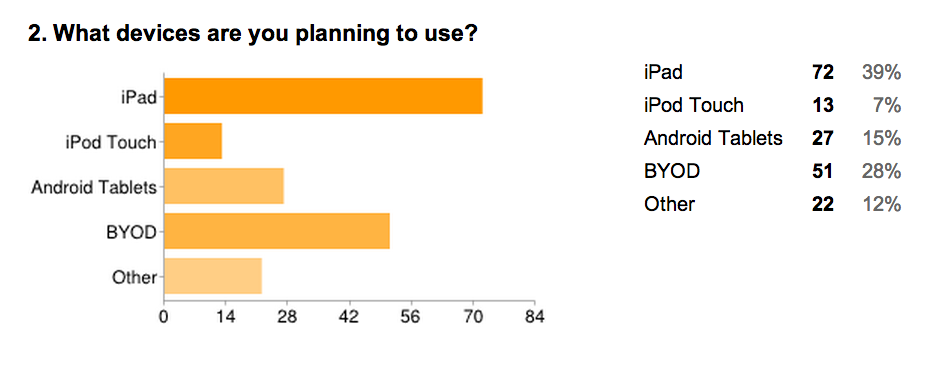
• I’m very pleased to have had as many as 140 responses to the survey. The answers to the multiple choice questions were fairly predictable:

    ImageThe transition to mobile is well underway, with the usual spectrum of early- to late-adopters.

    ImageiPads are where it’s at, but the strategy really has to embrace everything. At least no-one said “Google Glass” yet.

    As always, the insights were to be found in the comments. Some teachers see no benefit whatever to mobile

    …everything you can do on a iPad or Android device can be done on a PC.

    whilst others are looking into an exciting future, even if they don’t yet know in detail how to manifest it

    Less didactic teaching – more project based, providing resources, more group work, personalised learning, learners making choices about when they take assessments, learners choosing the materials that suit them best…

    and of course many simply express uncertainty.

    It seems most teachers at the start of the process are asking themselves the question “Can I (or how can I) run the existing system more efficiently with this new tool?”

    Those further down the track are starting to discover that usage evolves under its own logic, if you let it

    My sixth form students already use their own devices,initially  the biggest change I found that when asked a question they unsure on they turned to Google,  but they altered as they settled in  to the use in the classroom, attempting to answer first and then googling to see who was right, it was nice to see the development from reliance on the device to using it to support the knowledge they had.   (It wasn’t an easy path though!)

    What I hope to see if we run the same survey next year is that a few have moved beyond the current framework, and instead are looking outside education for inspiration. Apps and services like Foursquare, Google Goggles and Ease into 5k use a mobile devices’ sensors and capabilities to deliver experiences that are simply not possible in any other way. None of these three are particularly intended as educational apps, but each has potential. More importantly, they inspire us to look beyond classroom and curriculum, and into a new way to develop the minds of our young charges.

  •  

    The best time to plant a tree is 40 years ago. The second-best time is today.
    Chinese proverb

    I originally conceptualised Yacapaca as system that would be entirely teacher-controlled and teacher-led. That fits the market well, but I have always had a nagging  (more…)

  • CAN

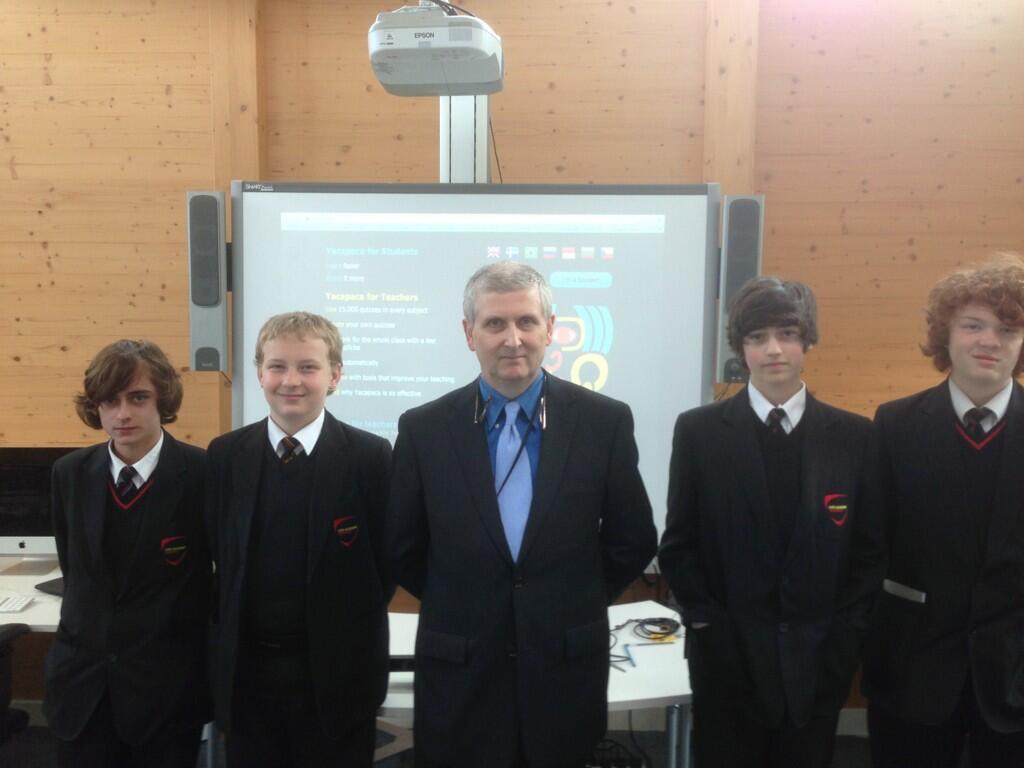
    I visited City Academy Norwich on Friday, to observe some lessons with Matt Wells and Jez Thompson. It was a particular pleasure to meet Jez; I have known him for donkey’s years, but we had never actually met.

    What struck me about the three lessons I observed was that there was no chalk and talk whatever. None. I don’t know if this is a school policy, but if it is then I approve. All the research shows that talking at kids doesn’t work; I suspect it actively inhibits their ability to learn by turning them off the whole experience. What I saw at CAN was kids on task, all the time. Some of that was Yacapaca, some was other activities.

    This was also my first opportunity to observe a Year 9 Computing lesson. I was amazed and delighted at the range of tasks the students were undertaking, and the level of engagement the tasks generated. Jez had each student either working on their own task, or in pairs, on a carrousel system. I had not seen this done before in such a fine-grained way, and it was extremely effective. Students were focused much more on their own tasks than what their peers were doing, and as a result were almost completely self-managed.

    My actual aim in going was to test out our (very) experimental “Tortoise and Hare” quiz template. And I’m glad I did, because results were fairly mixed and I think I would have missed the nuances of this had I relied only on third-party reports and log data. T&H has potential, but it’s a long way from ready. We shall iterate, and test again. I suspect there will be several rounds of testing before I am happy with it, so don’t expect to see it in production any time soon.

  • We have just updated Yacapaca with what I think is one of the most profound changes we have made.

    It’s called Self-Calibration. Your students will meet it as soon as they start their next quiz. Here’s why and how it works.

    Charles Darwin said that “Ignorance more frequently begets confidence than does knowledge”. You probably know students who consistently overestimate their own abilities. It is an emotional defence mechanism known as the Dunning-Kruger effect.  Students who over-estimate their own abilities are less likely to study and thus drive themselves into a vicious spiral of failure and denial.

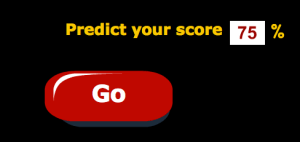
    Self-Calibration introduces a gentle but persistent way for students to build and ‘own’ a realistic view of their own abilities. At the start of each quiz, we ask the student to simply  “Predict your score”.

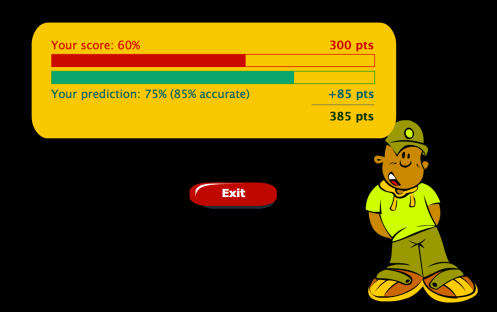
    At the end of the quiz we assign extra motivation points (that they can spend on new avatars) according to the accuracy of the prediction. Result? Over time, students start to care about self-calibration, and to get better at it.

    Self-Calibration appears automatically on all Yacapaca quizzes; you do not need to do anything to enable it. Please do observe it in action, talk to the students about it and give me feedback below on how well it is working.

  • September’s competition was held over three days this week, and was open to all experienced Yacapaca users. There were three prizes (see below) of subscription upgrades. We had a better-than-expected field:

    • 107 signups
    • 66 entries
    • 553 comparisons with comments
    • 159 votes

    The question I posed was: “Please explain the main problem that Yacapaca solves for you, that you have not been able to solve (or to solve as easily) in other ways.

    There were three winners, each chosen by your votes. All I did was read the results off my admin screen.

    Stage 1 winner: Leah Class from Edeavour High School

    Leah’s answer had the greatest resonance for the most people. Note it wasn’t the “best” but rather the one most participants agreed with. Here it is:

    Yacapaca enables me to provide end of unit tests for my students without having to create them from scratch myself. I find the quizzes very interactive and like the colourful graphics which are very student friendly. I also like the way different quizzes are contributed by teachers around the country so there is a variety and different approach to the same subject. I really like the markbooks which enables me to see what levels my students have achieved and then I can feed this information into my school mark books and show that I have created assessment opportunities for my students. I have not yet created my own end of unit tests but I should be inspired to do this myself. Unfortunately time is an issue as always in teaching and in fact after a very long and busy day and series of meetings I am now online doing this and some preparation for my lessons tommorow.

    Stage 2 winner: Hannah Bowen from The Appleton School

    Hannah’s judgements when comparing answers were closest to the overall consensus. You may wonder why there is a prize for that. The reason goes back to why I ran the competition in the first place. I wanted to know what aspects of Yacapaca constitute the core of what Yacapaca “is” in the minds of its users. I needed to know where the consensus is, where other methods are biased towards the opinions of the most eloquent or persistent commenters. Putting a prize on this stage gives everyone the incentive judge towards the consensus.

    Stage 3 winner: Derek Roberts from Downham Market High School

    Derek’s comments gathered the most votes by quite a margin. When I use this software as a learning tool (typically for CPD), the comments are more valuable than the initial question answers, hence they get a prize. Here is one of Derek’s 10 comments, which I think is fairly representative.

    I have selected this answer because the author has mentioned the use of the white board charting feature being used to encourage the use of teams and building a sense of responsibility to others and also that the problem solved was to find a way to test in a fun and interactive way.

    So, how will Yacapaca development change as a result of this?

    I’m still digesting the enormous amount of material generated, but I thought I’d share the first thing to come out of it which is the tag cloud.

    These are keywords drawn from all the answers. Size indicates frequency and colour means importance. You can see instantly what Yacapaca is all about: feedback! I’m already brainstorming different ways for Yacapaca to deliver even better feedback in the future. By the way, I’ll give a special mention to the first person to spot the ringer in this tag cloud, and give the correct explanation of how it got there. If you know anything about computational linguistics, it’s fairly easy (hint).