• Some of my favourite courses, organised by subject.

    Business & Economics

    Year 11 Business Communications Revision: Does what it says on the tin, and does it with very high quality. The feedback is truly formative, i.e. it does not just spoon-feed the right answer.

    Design & Technology

    Dawlish Community College Resistant Materials: A simple pictorial quiz. The real joy is when you come to do the analysis. The questions are very clearly tagged and the quiz analysis will return a simple graph showing you which machines the students can use safely, and which need some reinforcement. A great safety resource.

    English & Media

    Literacy Across the Curriculum: History: Nice mixed-question, high quality quizzes that really show what is possible. And a great literacy/history resource too!

    Geography

    Geographies of Sustainable Global Cities: Really interesting quizzes around two of the coolest cities on the planet: Dubai and Curitiba. It even gives a mention to my personal hero Jaime Lerner.

    History

    Age of Empires: Well-balanced quiz on the slave trade. A gruesome subject well-handled. I would love to see more from this author.

    ICT

    GCSE Computing A451 – Computer Systems: Excellent, rich quizzes with thoughtful formative feedback that will work well with the brighter kids who are taking Computing at GCSE. I have my fingers crossed that this is the first of a series.

    Maths

    Maths KS3 baseline tests, Doubling and halving. It’s a bit of a mystery why I am listed as the author of this. I was on the team that produced the 3000 base questions, but I certainly was not the creative driver. It’s excellent, nonetheless.

    Modern Foreign Languages

    Irish: CCEA Graded Objectives in Modern Languages, Level 1: There is an amazing flowering of Irish language resources on Yacapaca; I am really proud of what the community has achieved here. Plenty of French, German and Spanish too, but the Irish is a really unique resource.

    Performing Arts

    GCSE Listening: I spent so long listening (yes, listening) to these quizzes that I seriously jeopardised the deadline for this mailshot. Even if you don’t set them for your students, enjoy them for yourself.

    PSHE

    Sex and Drugs: Excellent scenario-based quizzes written by Michelle Smith, who at the time was the National Coordinator for Healthy Schools. She has since been snapped up by the altogether more glamorous Jamie Oliver Foundation.

    Religion

    GCSE OCR Religious Studies B Philosophy and Religious Ethics: If you want proof that multiple choice questions can make you think, try these.

    Science

    8J Magnets and electromagnets: Author Gavin Rayner consistently tops the Yacapaca quality ratings and you can see why. This is the perfect teaching resource in one neat package.

  • The idea behind ‘flipping the classroom’ is to video your didactic presentations and have the students watch them at home via YouTube or similar. It’s a great idea: research has shown that video leads to greater recall because students can pause, rewind, etc over bits they did not get the first time.

    What can be flipped?

    Here is my list of things students can now do at home, including the traditional ones

    * didactic presentations
    * demonstrations
    * practice exercises
    * essays
    * tests and low-stakes assessments
    * educational computer games
    * and probably much more

    In tertiary education, these are now routinely getting packaged up into MOOCs – Massively Open Online Courses that have been shown to be highly effective and highly engaging. Because they have many game-like aspects, they should work even better with secondary-aged students.

    So what’s left?

    With the students doing all this at home, you can now knock out a lot of teacher activities that are no longer necessary

    * patrol and control
    * taking the register
    * handing out/taking in worksheets, books, etc
    Now the difficult question for someone whose mortgage is paid through teaching. What’s left? Sitting in the staffroom drinking Maxwell House?

    A better use of resources.

    Actually, I am quite convinced that this is the wrong question. Instead, let’s ask “What else?”Β  Freed from the drudgery of classroom routine, how can you apply yourself to developing the young minds in your charge beyond what could have been done in the past?

    What would a flipped school look like?

    What I’m going to propose is a variation on theΒ Oxbridge tutorial system. Oxbridge separate teaching into “lectures” (that can now be flipped) and “tutoring” (Oxford) or “supervision” (Cambridge). Tutoring is done in small groups of 2-3 students with one tutor, and has the key aim of developing the students’ ability to think. The tutor’s role is to challenge and to guide the discussion, whilst the students work out the answers collectively.

    Organising this with just your own class is difficult: if you are tutoring 6 students, what do the other 24 do? It works best if organised on a whole-school basis. Let’s do the sums.

    • Teacher:student ratio 1:20. Including support staff this goes up to 1:15 or higher; I’ll take 1:18 to make tidier sums.
    • Tutor:student ratio required 1:3
    • If out of every 18 students 3 are in a tutor group, 15 will not be. Each student therefore spends 1/6 of his or her time in a tutor group, and 5/6 “flipped”.

    Wow, that’s an hour a day of small-group tutoring. What’s that going to do for your GCSE results?

    Doing this requires a complete reorganisation of the school, and that is precisely what I am calling for. Create open learning spaces where students can study individually as they would at home – or extend the ‘study leave’ idea and allow them to study at home if that if that works for them. Chop classrooms up into tutoring spaces organised for discussion, not presentation. Give staff intensive un-learning of redundant didactic habits so they can develop their tutoring skills. And, as a by-product, watch job satisfaction soar.

    So what are you waiting for. It’s still three weeks to the start of term in England. Get your sledge hammer, and go start remodelling classrooms!

  • Just a heads-up that Yacapaca will be down for summer maintenance all next weekend. We have a huge performance upgrade to install. Don’t expect new features: hopefully, all you will ever notice is that Yacapaca continues not to suck.

  • We have just finished beta-testing the Prizes! Personal Learning Account (PLA). It went so well that we soft-launched immediately. I will post more about just how it works later (becos I’m proud as punch of what the team has achieved) but basically it throws all the clever software we’ve got at the problem of crafting a truly individualised revision routine for each student.

    To generate really powerful motivation, we have linked study to real-world prizes like iPods. Rather than asking the schools to pay for this, we ask the parents.

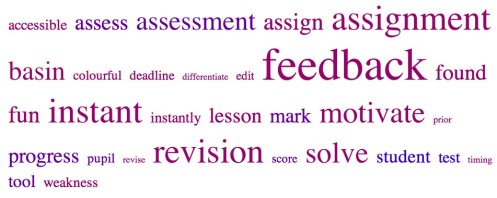
    At the end of the beta programme, I asked the students for feedback. Here is what they told me. I redacted their names, but otherwise this is verbatim:

    How many sessions did you do, approximately?

    What did you enjoy about it?

    What problems did you have?

    How could we make it better?
    4

    The incentive to revise as I could win prizes.

    The points I had prior to the beta were wiped once I was entered into the beta.

    10

    Concise simple questions, easy to learn and revise with.

    none

    More points
    100

    i enjoyed answering questions for revision and being able to win prizes.

    there were a few typo errors and somtimes when there were supposed to be pictures they were not there.

    Include a veriety of more subjects including craft and design or Home economics and if you added scottish qualification groups (SQA). Appart from that i realy enjoyed it.
    15

    It gives you something to look forward to and gives you a reason to revise and look forward to learning, it also means you can set yourself a target to achieve, unfortunately i didn't get round to ordering a prize even though I had the points. 😦

    None it's a brilliant idea, a few people have been saying the pictures could be a little more clear or define. But personally, from my perspective, it's fine because you only need to know what the picture stands for (e.g. the symbol for a variable resistor) and if you want to see fancy picture go to an art gallery.

    More prizes, but don't groan and say it goes over you budget or something because all you need are little things like sweets which wouldn't cost as many points (maybe 10,000 for a one or two packs of tangfastics) as kids would like this and it means they wouldn't have to save up loads of points. Also some people don't like iPods or don't want an amazon voucher but everybody likes sweets πŸ™‚
    8

    It was good because you had a whole range of topics, questions, examboards and years. The time you gave us was also good (to finish each question). The time limit idea is really good and flexible.

    The questions where you had to pinpoint a position in a photo was kind of confusing and not really accurate. Sometimes between questions took really long to load (but i think it was because there was a picture involved)

    I would put a timer so people can see how much they have left, or just some reminder. I'd also put an exit button which would exit the revision and save the points you got.
    10

    It was a nice and fun way to learn instead of just sitting on your table just keeping notes of what you read.

    I didn't find any problems I can remember of.

    Maybe the tests shouldn't be so strict on spelling. Also before the user submits his answer maybe there should be something that says are you sure that is your answer and it should say 'Yes or No'. Also before people do tests can we have a little revision lesson .
  • Being able to see every answer from every student is useful, but sometimes you can’t see the wood for the trees – it’s just too much detail. For a long time, I have wanted to offer key-concept analysis of every assignment, but have stumbled on the problem of finding someone to group our 120,000+ questions into meaningful categories.

    Finally, we have a solution. It’s called “crowdsourced analytics”, and I am delighted that we are launching it today. Here’s how it works…

    1. the first teacher to analyse a particular quiz enters their own analysis keywords, and groups the questions under them.
    2. every teacher who assigns that quiz to their own student has the choice of using the existing keywords, or adding their own.
    3. there is a hidden voting mechanism that will promote the most popular keywords so that over time a consensus of the most useful analysis terms will emerge.

    Access quiz analytics from the Assignments page. Click on the image below to see it large enough to read.